
A Spell Book for Sensemakers
Sensemaking is the deeply personal process we use to understand complex, messy, and/or ambiguous situations so we can make better decisions and take more thoughtful action.
- Complex: Many parts and many relationships
- Messy: Tangled because of people, history, and/or reality
- Ambiguous: Able to be interpreted in multiple ways
If you’ve ever watched someone skilled at knowing what to say, when to speak, or how to frame a decision so others could engage, then you’ve already seen sensemaking in action.
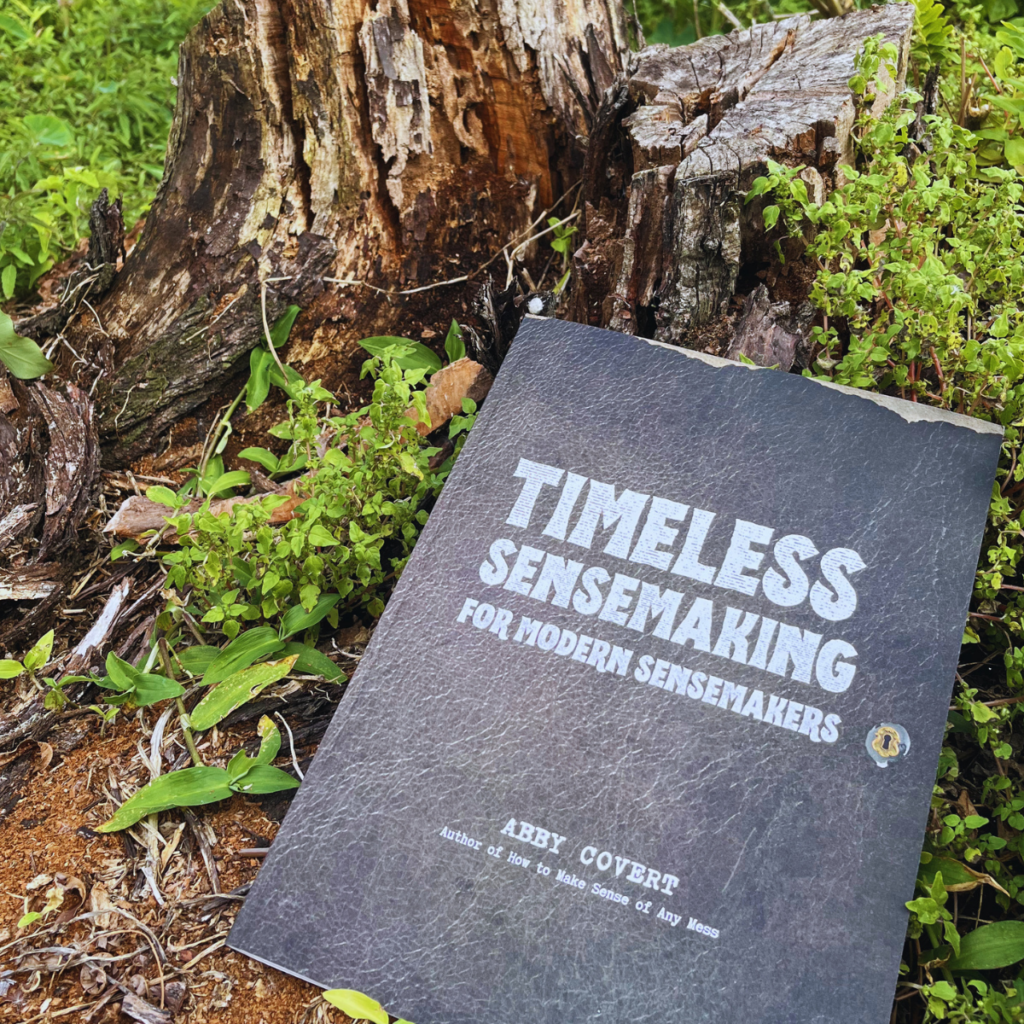
Timeless Sensemaking for Modern Sensemakers is a book for people doing real work with real people, where making sense actually matters. It borrows quietly from the idea of a spell book. Not in the sense of fantasy or mysticism, but in the older sense of a grimoire: a working collection of practices, observations, cautions, and tools, refined through use. It is written by a practitioner who has also walked alongside and taught thousands of people to make sense.
You’ll notice language about wearing masks, choosing an approach, and working with forces that aren’t always explicit, like power, incentives, timing, and structure. These are not metaphors layered on top of the work. They are the work.
Sensemaking often looks like intuition or common sense. In reality, it is more about pattern recognition, discernment, and timing, developed in context to your lived experience.
Every generation believes its complexity, messiness and ambiguity is unprecedented, and in its own way, that’s true.
But the work of sensemaking doesn’t change.
- People still misunderstand one another.
- Projects still fail because intentions and incentives are misaligned.
- Teams still need shared language before they can build shared things.
- Someone still has to ask, albeit sometimes quietly, “What problem are we trying to solve?”
That someone can be you. Not because you are the smartest person in the room, but because you care enough to slow down when everyone else is rushing, to listen before correcting, to hold two ideas at once without forcing one to win too early.
Who This Book Is For
This book is for people who find themselves:
- trying to explain something important and not being heard
- navigating stakeholders with competing priorities
- watching good ideas fail because they weren’t understood
- feeling the gap between what makes sense and what gets approved
If your work involves people, decisions, and ambiguity, this book was written for you.
What You’ll Learn
This is not a book of rigid frameworks or abstract theory. It is a working collection of practices you can use to:
- clarify what problem is actually being solved
- identify hidden incentives shaping decisions
- choose the right approach for different stakeholders
- make stronger arguments that actually land
- show the value of your work in ways others recognize
- move work forward, even when things are unclear
These are not “nice to have” skills. They are the difference between having insight and actually moving work forward.
Sensemaking is not a job title or a certification. It is a habit.
You practice sensemaking when you ask better questions, when you write things down so others can follow, when you admit you were wrong and redraw the map, when you help two people understand each other a little more than they did yesterday.
This moment is as it feels: unprecedentedly ambiguous, complex, and messy. This book will be here if you need guidance along the way.
What’s Inside
Timeless Sensemaking for Modern Sensemakers borrows quietly from the idea of a spell book. Not in the sense of fantasy or mysticism, but in the older sense of a grimoire: a working collection of practices, observations, cautions, and tools, refined through use.
Chapter I: WHO
Stakeholder Approaches
Learn how to choose the right approach for each person involved, so your work actually moves forward.
Chapter II: HOW
Sensemaking Practices
Build the core practices that strengthen your ability to think, communicate, and adapt in real time.
Chapter III: WHY
Incentive Architecture
Uncover what actually motivates people, so you can work with reality instead of against it.
Chapter IV: WHEN
Return on Investment
Learn how to demonstrate the value of your work in ways others recognize and support.
Chapter V: WHAT
Structural Arguments
Strengthen your ideas so they land not just logically, but emotionally and politically.
Chapter VI: WHERE
Sensemaking the Game
Practice all of this in motion, using a game designed to simulate the real dynamics of messy work.
Timeless Sensemaking for Modern Sensemakers is designed to be used, not just read.
You can move through it front to back, but you don’t have to. Each chapter stands on its own, offering a different entry point into the practice of sensemaking—whether you’re thinking about people, incentives, timing, structure, or the shape of an argument.
This book was written by the same author as How to Make Sense of Any Mess and Stuck? Diagrams Help. If those books invited you into the sensemaking practice, this book is here to stay with you as you develop your practice so it holds up in the people part.
The ideas inside are meant to be tried on in real situations. To be adapted. To be questioned. To be returned to after something didn’t go as planned.
Throughout the book, you’ll find exercises, lenses, and prompts you can use on your own or with others. These are not theoretical. They are drawn from real work, in real contexts, where clarity had to be built step by step.
Over time, the goal is not to memorize these approaches, but to internalize them so that in the moments that matter, you have more ways to see what’s happening and more options for what to do next.
If you are ready to strengthen how you think, communicate, and move work forward in complex environments, this book will meet you there.
Timeless Sensemaking for Modern Sensemakers is now available as a paperback, or PDF.